Balancing Data Privacy and AML Compliance in India — A Tough Act
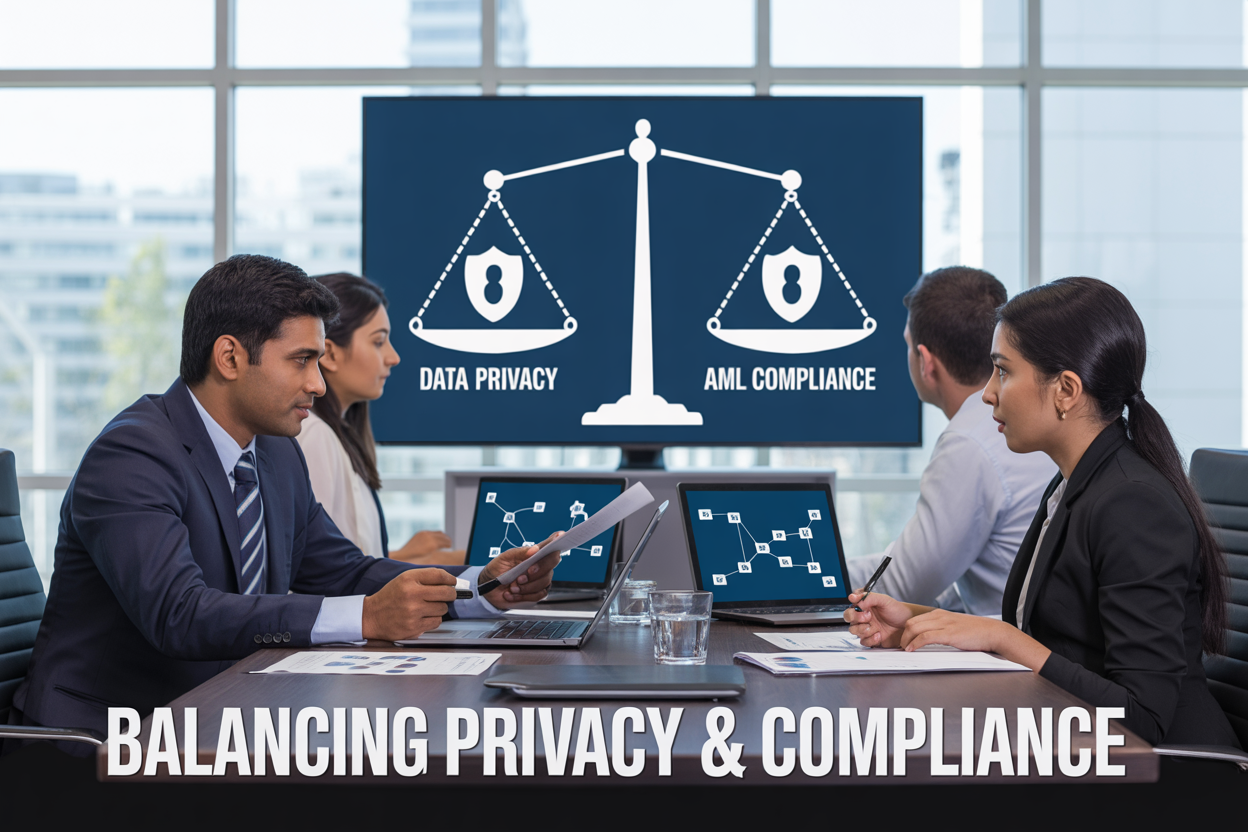
Balancing Data Privacy and AML Compliance in India — A Tough Act
Financial institutions, compliance officers, and legal teams in India face a growing challenge: protecting customer data privacy while meeting anti-money laundering requirements. New privacy regulations demand strict data protection, but AML compliance requires extensive data collection and sharing with authorities.
This guide is for banks, fintech companies, and compliance professionals who need to navigate both data privacy and AML obligations without compromising either. We'll explore how India's evolving privacy landscape clashes with established AML frameworks, then dive into practical solutions that help organizations meet both requirements. You'll also discover how technology can streamline dual compliance and learn to build internal capabilities that make sustainable compliance possible.
The stakes are high—regulatory penalties, reputation damage, and operational disruptions await those who get it wrong. But with the right approach, you can turn this compliance challenge into a competitive advantage.
Understanding India's Data Privacy Landscape and AML Framework

Key Provisions of India's Personal Data Protection Bill and Their Impact on Financial Institutions
India's Personal Data Protection Bill represents a sweeping transformation in how financial institutions handle customer information. The legislation mandates explicit consent for data collection, processing, and storage, creating significant operational challenges for banks and financial entities that have traditionally relied on broad customer agreements.
Financial institutions must now implement granular consent mechanisms, allowing customers to choose specific data uses rather than accepting blanket permissions. This granular approach affects everything from credit scoring to marketing activities. Banks can no longer assume consent for cross-selling products or sharing data with subsidiaries without explicit customer approval for each purpose.
The Bill introduces strict data localization requirements, mandating that sensitive personal data remains within India's borders. For financial institutions with global operations, this means restructuring data architectures, establishing local data centers, and potentially duplicating systems. The costs associated with compliance run into millions of dollars for larger institutions.
Data retention limitations pose another challenge. Financial institutions must demonstrate clear business justification for retaining customer data beyond specified periods. This conflicts with traditional banking practices where customer data was retained indefinitely for relationship management and regulatory purposes.
RBI's AML Guidelines and Reporting Requirements for Banks and Financial Entities
The Reserve Bank of India's AML framework requires comprehensive customer due diligence, ongoing transaction monitoring, and suspicious transaction reporting. Banks must collect and verify extensive customer information, including identity documents, financial statements, and source of funds documentation.
KYC requirements demand detailed customer profiling, including beneficial ownership identification for corporate accounts. Financial institutions must maintain updated customer information and conduct periodic reviews based on risk assessments. High-risk customers require enhanced due diligence, involving additional documentation and more frequent monitoring.
Transaction monitoring systems must flag unusual patterns, cash transactions exceeding specified thresholds, and activities inconsistent with customer profiles. Banks must report suspicious transactions to the Financial Intelligence Unit within seven days of detection. This reporting includes detailed customer information, transaction patterns, and reasons for suspicion.
Record-keeping requirements mandate retention of customer identification records for five years after account closure and transaction records for five years after completion. These requirements ensure availability of information for regulatory investigations and law enforcement requests.
Overlapping Jurisdictions Between Data Protection Authorities and Financial Regulators
The regulatory landscape creates complex jurisdictional overlaps between the proposed Data Protection Board and financial sector regulators like RBI, SEBI, and IRDA. Financial institutions face potential conflicts when data protection requirements clash with sector-specific regulations.
RBI's supervisory powers include on-site inspections and access to customer data for regulatory purposes. However, data protection laws may restrict such access without proper legal basis or customer consent. This creates uncertainty about regulator access rights and institutional obligations.
Cross-border data sharing for AML investigations presents jurisdictional challenges. While RBI may require information sharing with foreign regulators or law enforcement agencies, data protection laws restrict international data transfers without adequate safeguards or regulatory approval.
Enforcement actions may come from multiple regulators simultaneously. A single data handling incident could trigger investigations by both financial regulators and data protection authorities, leading to overlapping proceedings and potentially conflicting remedial orders.
Critical Compliance Deadlines and Penalties for Non-Adherence
Data protection compliance deadlines vary based on institutional size and data processing volumes. Large financial institutions have shorter implementation timelines due to their significant data processing capabilities and customer base size.
Penalty structures differ significantly between data protection and AML regulations. Data protection violations can result in fines up to 4% of annual turnover or ₹15 crores, whichever is higher. AML non-compliance penalties include monetary fines, license cancellation, and criminal prosecution for willful violations.
The penalty calculation methodology considers violation severity, institutional size, cooperation with investigations, and remedial measures taken. Repeat violations attract enhanced penalties and may result in business restrictions or leadership changes.
Compliance deadlines also include breach notification requirements. Data breaches must be reported to authorities within 72 hours of discovery, while suspicious transaction reporting has different timelines based on transaction types and risk levels.
Identifying Core Conflicts Between Privacy Rights and AML Obligations

Customer Data Collection Limits Versus Comprehensive Due Diligence Requirements
Financial institutions face a tricky situation when collecting customer information. Data privacy laws push for minimal data collection — grab only what you absolutely need for the specific purpose. But AML regulations demand extensive customer due diligence that goes way beyond basic account opening requirements.
Banks need detailed information about customers' income sources, business activities, beneficial ownership structures, and transaction patterns. Privacy frameworks question whether collecting employment history, family details, or extensive financial backgrounds truly serves the stated purpose of opening a simple savings account.
The conflict becomes sharper with enhanced due diligence for high-risk customers. AML rules require deep dives into politically exposed persons' family connections, business associates, and wealth sources. Privacy advocates argue this level of intrusion exceeds proportionality principles, especially when customers haven't engaged in suspicious activities.
| AML Requirements | Privacy Concerns |
|---|---|
| Extensive background checks | Proportionality questions |
| Family and associate details | Relevance to core service |
| Historical financial data | Data minimization violations |
| Ongoing monitoring profiles | Purpose limitation conflicts |
Data Minimization Principles Conflicting With Suspicious Transaction Monitoring Needs
Data minimization sits at the heart of modern privacy legislation — collect less, store less, use less. This principle crashes head-on with AML monitoring systems that thrive on comprehensive data analysis. Effective transaction monitoring requires building detailed customer profiles that capture spending habits, geographical patterns, and behavioral baselines.
AML systems analyze years of transaction history to establish normal patterns and detect anomalies. They cross-reference customer data with multiple databases, creating rich profiles that privacy laws would consider excessive. Machine learning algorithms need diverse data points — transaction amounts, frequencies, merchant categories, geographic locations, and timing patterns — to function effectively.
Privacy regulations question whether banks can justify retaining five years of detailed transaction data when the original purpose was facilitating payments. The tension intensifies when monitoring systems flag innocent customers based on algorithmic analysis of their historical patterns, raising questions about automated decision-making and profiling restrictions.
Financial institutions struggle to explain how collecting data about a customer's coffee purchases helps prevent money laundering, even though such micro-patterns contribute to comprehensive risk assessment models.
Right to Erasure Challenges in Maintaining AML Audit Trails and Records
The right to be forgotten creates nightmares for AML compliance teams. Customers can request deletion of their personal data, but AML regulations mandate keeping detailed records for extended periods. This creates an impossible choice — comply with erasure requests and violate AML record-keeping requirements, or maintain AML files and breach privacy rights.
Record retention periods vary significantly between jurisdictions, but AML requirements typically span 5-10 years after relationship termination. Some jurisdictions extend this period for suspicious activity reports or ongoing investigations. When customers invoke erasure rights shortly after closing accounts, banks face immediate compliance conflicts.
The challenge multiplies with shared data across banking groups or correspondent relationships. A customer might request erasure from one entity while their data remains necessary for AML compliance at related institutions. Determining which data elements fall under AML exemptions versus privacy obligations requires complex legal analysis that varies by jurisdiction.
Regulatory guidance remains unclear about balancing these competing requirements. Some privacy authorities acknowledge AML exemptions, while others maintain strict erasure obligations regardless of other regulatory requirements.
Cross-Border Data Transfer Restrictions Impacting Global AML Screening Processes
Global AML screening hits major roadblocks when data localization and transfer restrictions enter the picture. Banks need to screen customers against international sanctions lists, politically exposed person databases, and adverse media sources that often require cross-border data sharing.
Many countries now restrict personal data transfers to jurisdictions without adequate protection levels. This creates operational headaches for multinational banks that need centralized AML screening capabilities. Customer data might need screening against databases located in different jurisdictions, but transfer restrictions prevent efficient processing.
Real-time transaction monitoring becomes particularly challenging when data residency requirements force banks to process transactions locally while comparing against global watchlists. The latency and complexity of managing multiple screening systems across jurisdictions increases false positive rates and reduces monitoring effectiveness.
Correspondent banking relationships suffer significantly from these restrictions. Banks need to share customer information for joint AML screening, but privacy laws often prohibit such transfers without explicit customer consent — consent that customers rarely provide for AML purposes.
Some jurisdictions create specific carve-outs for AML data transfers, but these exceptions rarely align across different privacy regimes, creating patchwork compliance requirements that vary by customer location and transaction routing.
Practical Solutions for Achieving Regulatory Balance

Implementing Privacy-by-Design Frameworks in AML Technology Systems
Privacy-by-design represents a fundamental shift from treating data protection as an afterthought to embedding it directly into the architecture of AML systems. Financial institutions in India are discovering that this proactive approach doesn't just satisfy regulatory requirements—it actually enhances the effectiveness of their compliance programs.
The core principle involves building AML systems that collect only the minimum data necessary for compliance purposes. Instead of casting a wide net and gathering excessive customer information, institutions can deploy intelligent data collection mechanisms that adjust based on risk profiles. For instance, a low-risk domestic transfer might require only basic identity verification, while high-value international transactions trigger more comprehensive data collection protocols.
Technical implementation starts with data minimization algorithms that automatically determine the optimal data points needed for each transaction type. These systems can dynamically adjust collection parameters based on real-time risk assessments, ensuring that privacy intrusion remains proportional to actual risk levels. Many banks are now using machine learning models that learn from historical patterns to predict exactly which data elements will be most valuable for suspicious activity detection.
Pseudonymization techniques play a crucial role in privacy-by-design AML systems. Customer data can be processed through cryptographic methods that allow pattern recognition and suspicious activity detection without exposing actual personal identifiers during routine analysis. Only when genuine suspicious activity is detected do authorized personnel gain access to de-pseudonymized data for investigation purposes.
Developing Data Governance Policies That Satisfy Both Regulatory Requirements
Effective data governance policies must navigate the complex intersection between the Data Protection Act's privacy mandates and RBI's AML requirements. This balance requires sophisticated policy frameworks that clearly define when, how, and for what duration different types of data can be collected, processed, and retained.
Successful institutions are adopting tiered data classification systems that categorize information based on both privacy sensitivity and AML relevance. Personal financial data receives the highest protection level, requiring explicit consent and strict access controls, while transaction pattern data might be processed under legitimate interest provisions for fraud detection purposes.
Data retention policies present particular challenges, as AML regulations often require longer retention periods than privacy laws prefer. Smart governance frameworks address this by implementing automated data lifecycle management systems that gradually reduce data granularity over time. Recent transaction details might be kept in full for immediate compliance needs, while older records are progressively anonymized while retaining statistical patterns useful for long-term trend analysis.
Clear data usage matrices help organizations understand exactly which data elements can be used for specific purposes. These matrices map each type of customer data against permitted uses under both privacy and AML frameworks, preventing unauthorized data processing while ensuring compliance teams have access to necessary information.
Creating Customer Consent Mechanisms for Enhanced Due Diligence Procedures
Customer consent management becomes significantly more complex when AML requirements demand enhanced due diligence procedures. Traditional binary consent models—where customers simply agree or disagree to data processing—prove inadequate for the nuanced requirements of financial compliance.
Granular consent mechanisms allow customers to understand and approve specific types of data collection for different purposes. Instead of blanket permissions, customers can consent to basic transaction monitoring while separately approving additional data collection for enhanced due diligence if their risk profile changes. This approach maintains customer autonomy while ensuring institutions can meet their compliance obligations.
Dynamic consent systems represent the next evolution, automatically requesting additional permissions when circumstances require enhanced due diligence. For example, if a customer's transaction patterns trigger risk indicators, the system can immediately request consent for additional data collection or verification procedures. These requests include clear explanations of why additional information is needed and how it will be used.
Consent documentation systems must maintain comprehensive audit trails showing exactly what permissions were granted when and for what purposes. This documentation proves essential during regulatory examinations and helps institutions demonstrate that all data processing activities have appropriate legal basis.
Establishing Secure Data Sharing Protocols with Law Enforcement Agencies
Data sharing with law enforcement agencies represents one of the most sensitive aspects of AML compliance, requiring robust protocols that protect customer privacy while meeting legal obligations. Secure technical infrastructure forms the foundation of effective sharing protocols, typically involving encrypted communication channels and access-controlled data repositories.
Automated sharing systems can identify when transaction patterns or customer behavior triggers mandatory reporting requirements, instantly generating Suspicious Transaction Reports (STRs) or Cash Transaction Reports (CTRs) without human intervention in routine cases. These systems ensure consistent reporting while minimizing human access to sensitive customer data.
Legal framework alignment ensures that all sharing protocols comply with both AML reporting requirements and data protection limitations. Institutions must clearly document the legal basis for each type of data sharing, whether under specific AML provisions, court orders, or other legal authorities. Regular legal review cycles keep these protocols current with evolving regulatory requirements.
Access logging and monitoring systems track every instance of data access by law enforcement agencies, creating comprehensive audit trails that demonstrate compliance with both sharing obligations and privacy protections. These logs help institutions identify potential misuse while providing evidence of proper compliance during regulatory examinations.
Technology-Driven Approaches for Dual Compliance Success

Leveraging Artificial Intelligence for Privacy-Preserving Transaction Monitoring
Modern AI systems now offer sophisticated ways to monitor suspicious transactions while keeping customer data under wraps. Machine learning algorithms can analyze transaction patterns without exposing actual customer identities or sensitive financial details. These systems work by creating anonymized data models that flag unusual behaviors based on spending patterns, frequency, and transaction characteristics rather than personal identifiers.
Privacy-preserving machine learning techniques like federated learning allow banks to train AI models across multiple data sources without centralizing sensitive information. This approach lets financial institutions maintain robust AML monitoring while ensuring customer data never leaves secure environments. Differential privacy adds another layer of protection by introducing mathematical noise to datasets, making it nearly impossible to reverse-engineer individual customer information.
Banks can deploy AI systems that score transactions for risk levels while maintaining data anonymity throughout the process. When suspicious activity gets flagged, the system can alert compliance teams without revealing unnecessary personal details until proper authorization procedures are followed. This selective disclosure approach satisfies both AML requirements for detection and privacy demands for data protection.
Implementing Blockchain Solutions for Secure and Auditable Compliance Records
Blockchain technology creates tamper-proof audit trails that satisfy regulatory requirements while maintaining data integrity. Smart contracts can automate compliance workflows, ensuring consistent application of AML rules without human intervention that might compromise data handling protocols. These distributed ledger systems provide real-time visibility to regulators while maintaining strict access controls.
Private or consortium blockchains offer the perfect middle ground for financial institutions. They provide the transparency regulators need for AML oversight while restricting access to authorized parties only. Transaction records become immutable once recorded, creating an unalterable compliance history that satisfies audit requirements.
| Blockchain Feature | AML Benefits | Privacy Advantages |
|---|---|---|
| Immutable Records | Tamper-proof audit trails | No retroactive data changes |
| Smart Contracts | Automated compliance checks | Reduced human data exposure |
| Access Controls | Selective transparency | Restricted data visibility |
| Cryptographic Hashing | Data integrity verification | Information anonymization |
Deploying Advanced Encryption Methods to Protect Sensitive Customer Information
End-to-end encryption ensures customer data remains protected throughout the entire AML compliance process. Advanced encryption standards like AES-256 combined with homomorphic encryption allow computations to be performed on encrypted data without decrypting it first. This means AML algorithms can analyze transaction patterns while customer information stays completely encrypted.
Tokenization replaces sensitive data elements with non-sensitive equivalents that retain essential information for AML analysis. Credit card numbers, account details, and personal identifiers get replaced with randomly generated tokens that maintain referential integrity for compliance purposes while rendering the actual data useless if compromised.
Key management systems ensure encryption keys are properly rotated and secured according to both AML and privacy requirements. Multi-party computation allows different organizations to jointly compute functions over their inputs while keeping those inputs private from each other, enabling collaborative AML efforts without data sharing concerns.
Automated Reporting Systems That Minimize Human Data Exposure
Intelligent reporting systems can generate required AML reports while minimizing the number of people who access raw customer data. These platforms automatically extract necessary information, format it according to regulatory requirements, and submit reports without human intervention in the data handling process.
Role-based access controls ensure only authorized personnel can view specific data elements necessary for their compliance functions. Automated masking systems can hide or obscure sensitive information from users who don't require full access, showing only relevant details needed for their specific AML tasks.
Real-time monitoring dashboards present aggregated compliance metrics without exposing individual customer records. These systems alert compliance teams to potential issues while maintaining customer privacy through statistical reporting rather than detailed transaction displays. When investigations become necessary, proper approval workflows ensure data access follows both AML requirements and privacy protection protocols.
Building Organizational Capabilities for Sustainable Compliance

Training Compliance Teams on Integrated Privacy and AML Risk Management
Building a skilled compliance workforce requires a strategic shift from traditional siloed training approaches to comprehensive, integrated programs. Teams need to understand how data privacy laws intersect with AML requirements, creating scenarios where professionals must balance competing obligations.
Effective training programs begin with foundational knowledge of both regulatory frameworks. Staff should master the nuances of India's Digital Personal Data Protection Act alongside the Prevention of Money Laundering Act. This dual expertise helps identify potential conflicts before they become compliance failures. Role-specific modules address different responsibilities - customer onboarding teams learn privacy-by-design principles while maintaining KYC thoroughness, while data analysts understand appropriate data minimization techniques without compromising transaction monitoring effectiveness.
Scenario-based learning proves most valuable for developing practical skills. Teams work through realistic case studies involving suspicious transaction reporting while protecting customer privacy rights. Interactive workshops simulate data breach situations affecting AML records, testing response protocols and decision-making under pressure. Regular assessments ensure comprehension and identify knowledge gaps requiring additional attention.
Cross-training initiatives break down departmental barriers. Privacy officers learn AML investigation processes while compliance analysts understand data protection impact assessments. This shared knowledge creates more collaborative working relationships and prevents regulatory blind spots.
| Training Component | Frequency | Target Audience | Key Outcomes |
|---|---|---|---|
| Regulatory Updates | Monthly | All compliance staff | Current law interpretation |
| Case Study Analysis | Quarterly | Team leads and analysts | Practical application skills |
| Cross-functional Workshops | Bi-annually | Multi-department teams | Collaborative problem-solving |
| Technology Training | As needed | Technical and compliance staff | Tool proficiency |
Establishing Cross-functional Governance Committees for Policy Alignment
Successful dual compliance requires organizational structures that bridge traditional departmental boundaries. Cross-functional governance committees ensure policy coherence across privacy and AML domains while maintaining accountability for regulatory outcomes.
These committees typically include representatives from compliance, legal, technology, operations, and business units. Privacy officers and AML compliance officers serve as co-chairs, ensuring balanced perspectives in decision-making processes. Regular meetings address policy conflicts, review emerging regulatory guidance, and coordinate responses to examination findings.
Committee responsibilities extend beyond policy creation to implementation oversight. Members monitor compliance metrics across both domains, identifying trends that might signal systemic issues. They review and approve technology implementations affecting either privacy or AML requirements, ensuring solutions address both regulatory needs without creating new conflicts.
Effective committees establish clear escalation pathways for complex issues requiring senior management attention. They create standardized assessment frameworks for evaluating new products or services against both regulatory requirements. Documentation standards ensure decisions are traceable and defensible during regulatory examinations.
Regular committee outputs include updated policy documents, risk assessment reports, and training requirements. These deliverables maintain organizational alignment and provide evidence of proactive compliance management to regulators.
Creating Incident Response Protocols for Data Breaches Involving AML Data
Data breaches affecting AML information create unique challenges requiring specialized response protocols. Standard breach response procedures must accommodate additional regulatory reporting requirements and investigative complexities while protecting ongoing AML investigations.
Response protocols begin with immediate containment and assessment procedures tailored to AML data sensitivity. Teams must quickly determine whether compromised information includes customer identification data, transaction records, or suspicious activity reports. Different data types trigger varying notification requirements and protective measures.
Parallel reporting obligations require careful coordination. While privacy laws mandate customer notification within specified timeframes, AML considerations may require delayed disclosure to prevent investigation interference. Response protocols establish clear decision trees helping teams balance these competing requirements while maintaining regulatory compliance.
Immediate Response Checklist:
-
Isolate affected systems to prevent further exposure
-
Assess scope and sensitivity of compromised AML data
-
Notify internal stakeholders including compliance and legal teams
-
Document all response actions for regulatory reporting
-
Coordinate with law enforcement if criminal activity suspected
-
Prepare preliminary impact assessments for both privacy and AML implications
Communication strategies address multiple stakeholder groups with different information needs. Customers receive privacy-focused notifications emphasizing protective measures taken, while regulators receive detailed technical assessments including potential AML investigation impacts. Internal communications keep business units informed without compromising ongoing investigations.
Recovery procedures include enhanced monitoring for affected accounts and expedited review of related AML cases. Post-incident analysis identifies root causes and system vulnerabilities, leading to strengthened controls that prevent similar breaches. These lessons learned feed back into training programs and policy updates, creating continuous improvement cycles that enhance organizational resilience against future incidents.

Financial institutions in India face a complex puzzle when trying to protect customer data while meeting strict anti-money laundering requirements. The key is finding smart ways to handle both responsibilities without compromising either one. Companies that invest in the right technology, clear processes, and proper training will be better positioned to navigate these competing demands.
The path forward requires a proactive approach rather than a reactive one. Organizations need to build strong frameworks that treat privacy and compliance as complementary goals, not opposing forces. By embracing innovative solutions like privacy-enhancing technologies and developing comprehensive policies, financial institutions can turn this regulatory challenge into a competitive advantage while keeping customer trust intact.


Comments
Post a Comment